
Sunday Special #4 "Dusting My Stack to a Bracelet Winner"
The first Sunday Special from a reader submission.

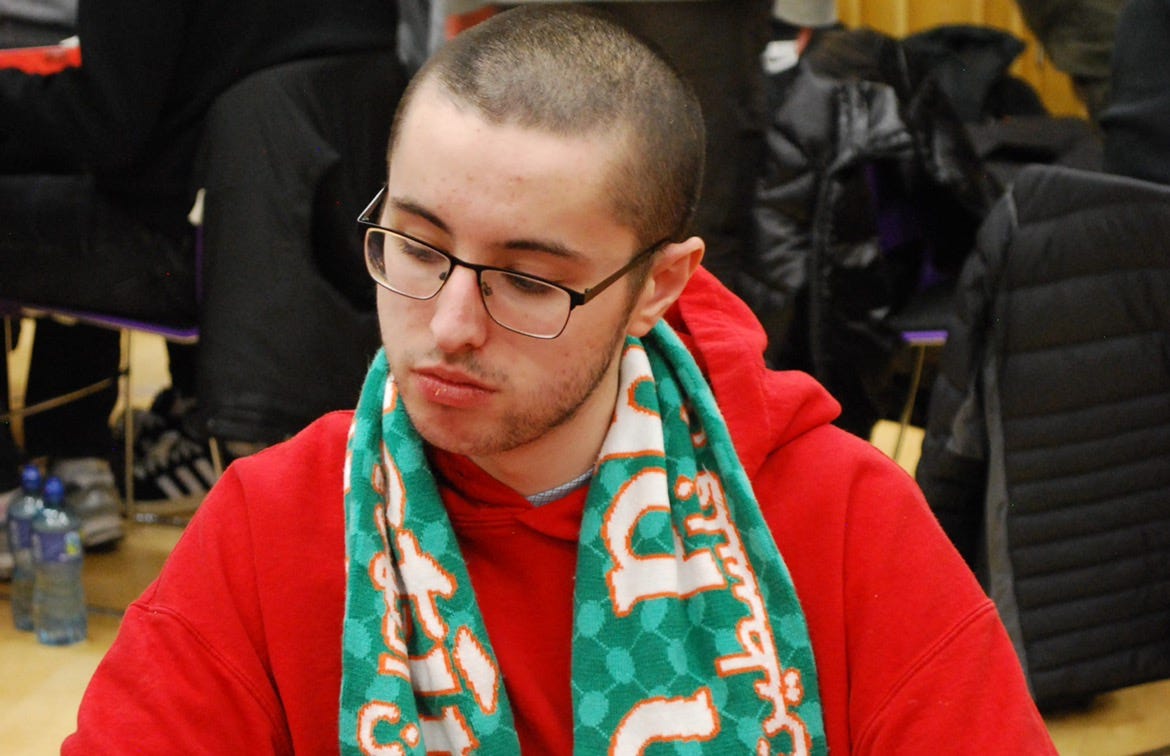
Today’s Punter is Jack Reynolds he has a poker strategy substack, that you can read and subscribe to below.
As always my thoughts are included in the footnotes. If you reading this via e-mail, it might be an easier read on Substack where the footnotes require less scrolling back and forth. Click here.
If you are interested in being the subject of a future Sunday Special, let me know. Do not be shy if you have a lack poker skill or accomplishments. No solver analysis is required from you and I’d much rather have amateur poker players, who are good writers that can produce clean copies and clearly articulate their thought process than editing the writing of 99% of accomplished poker players. Onto Jack’s hand.
Three and a half years ago, I walked into my university’s poker society to play their weekly tournament, and was instantly hooked. What started as a hobby among friends quickly became an obsession. I bought Dara O’Kearney’s books, began watching training videos, playing online and doing anything I could to learn as much about poker as quickly as possible.
I’ve managed to begin a career in the poker industry as a video editor, but I still aim to play as much as I can, switching between long low-stakes grinds online and getting away a few times a year to some of Ireland’s more beautiful places
This month, I attended the Galway Poker Festival, just one year removed from making my first ever live final table at the very same festival. I came in with hopes and dreams, and by the final day, I was ready to leave with nothing but a dented bankroll and feelings of dejection and deflation. However, I had one final shot, a satellite into the €400 side event. After my second bullet proved to be fruitful, I went for lunch, and then sat down in my festival saver, only to find myself going to battle with Mitchell Hynam, fresh off his first bracelet last summer. Many people would tend to avoid the best player in the room, but I lack this certain soft skill, and perhaps have an ego problem that will usually lead me to clashing in massive pots with these players, trying to get one up on them.
2026 Galway Poker Festival - Galway €400 (800/1600/1600) (SB/BB/BBA) Level 9. Registration is open.
It folds to me in the HJ (52,800) with J♣️9♣️ and I raise 3.2k, Mitchell Hynam (110,000) 3bets to 11,200 from the SB and I call.
Flop (26,400) K♥️K♦️5♦️ Mitchell checks, I check.
Turn (26,400) T♣️ Mitchell checks, I bet 11,000 Mitchell calls.
River (48,400) 8♣️ Mitchell checks, I jam 30,800, Mitchell calls and shows J♥️J♠️
What I was thinking:
Preflop was a standard open, and facing the 3bet my hand is at best a marginal continue. However, Mitch had been redlining the table and I had been told that at these particular lowstakes festivals, he is always a few pips too wide against recreationals.1 I figured the best way to combat a wider 3bet range was to continue more of my marginal hands in position.2
On the flop, I assumed he had a pretty standard small bet with range and I was going to snap fold with no backdoor flush draw.3 Once he checked, I was thrown for a loop. I felt the check capped his range and his only nutted hands that would check would be one combo of KK and two combos of K5s.4 I knew I could start bluffing a lot of Qx and Jx right away but thought I would want a backdoor flush to rifle it off from the flop.5
When he checked on the turn, I felt I had a slam dunk bluff now.6 Turning equity with the gutshot added to the appeal, and I felt blocking KJs and K9s was enough on the blocker properties.7 Most importantly, I knew I needed to bluff clubs and spades at some frequency, and not just hearts, so I could have bluffs on non-flush completing rivers.8
The second the river hit, I knew I was going to be all-in. I was close to the bottom of my range, Mitch was capped, I unblocked missed flush draws, I blocked value combos, and I didn’t really block autofolds.9 Most importantly, against such a good player, I felt I needed to bluff here.10 Against recs, it’s easy to underbluff because they’re often not going to recognise I gave up a pure follow through, and won’t begin to exploit me, but if Mitch knows I am not going to rifle off J high, how am I ever going to value bet against him.11 So I sucked it up, and stuck my stack in with nothing but jack-high and a dream, but unfortunately Mitch had an easy call with his hand.12
After I busted, I thought about if I had enough value that took this line with my stack depth, and I believe I do. Being in position at this depth, I figured I would slowplay hands like AA and KK pre, as well as calling a lot of suited Kings due to only a 3.5x 3bet size.13 My main problem with the hand is a trend I have noticed in my own play. I often take low frequency lines against great players to arrive at awkward nodes and dissipate their edge, but I’m not nearly well studied enough to gain an advantage in these complex river nodes. In these rec-heavy tournaments, maybe I should stop forcing massive pots with better players, and instead focus on taking chips from the very obvious spots at the table.14
Despite this very clear leak in my game, I can’t say I’m upset with how I played the hand. I’ve dedicated a lot of my study time to the idea of stacking bluffs for all runouts, and while I may lack certain exploitative tendencies that can keep me from dusting my stack to the best player in the tournament, I can happily say I found a semi-creative bluff in the biggest tournament of my festival, and gifted my stack to a bracelet winner.15
GTO Wizard has this being a mixed call vs. a three-bet to 12k, so I think it’s a good call vs. someone three-betting too often to a smaller size. Especially if he’s not playing any shoves and has AK/AQ pure, and he’s out of line and three-betting some combos like K6s or A5o.
Four-bet bluff-shoving wider is another way to do it, but this hand is not quite the right class of hand. A5s, KTs, small pairs, and QJs seem appropriate hands to add to your shoving range here.
Both of these assumptions are correct.
My default assumption when an aggressive player misses a pretty easy pure c-bet is that they rarely have air. They might have middle of range or they might have the stone nuts, but they usually have something.
If you want to bucket slightly stronger hands into aggressive bluffing lines vs. strong opponents, this is a reasonable adjustment, but in the solver land you don’t need a backdoor here. On a board like JJ4, you start blasting off all sorts of hands with no backdoors.
Again, you don’t need equity to bluff here. His hand looks a lot like AQ/AJ or 77 and you have two streets to play; you can just bluff with 76s or A9s type hands. However, bluffing with equity is a fine play, especially when you have jack high— if you can get him to fold anything he’s probably folding a better hand.
I am not sure this matters much because he can have KJo preflop, but more importantly, I really doubt he is checking trips twice.
This is correct. However, it’s possible AJ is a hand you’re trying to get to fold a bunch, which makes a jack less than ideal to bluff with, but you’ll run into problems like that with basically every hand you’re bluffing with outside of hands like 76s.
I agree with the first three points, but I don’t think you block much value and you unblock a potential x/f in AJ.
It took 10 footnotes for me to get to the real crux of this hand. I think because you are intimidated by Mitch’s success you feel the need to play balanced and solvery, but you are ignoring a key detail in the hand. Mitch checked range on a pure c-bet flop; he is not playing balanced and solvery vs. you. When a good player who leans over-aggro vs. recs misses a pretty clear range bet, I think a reasonable adjustment is to assume he has a pretty good hand and he’s not folding enough to make betting with air a good play on any street.
I think you need to be careful to not overdo this. There is another type of archetype here, the player who feels the need to prove themselves to the pro, finds every thin bluff, and the pro adjusts by saying “lol, this guy is always bluffing, I call.”
His flop check surprised me, but his turn check is downright shocking. It seems like he has a very clear value bet on the turn to try to stack Tx. I don’t think he can rely on many people in this tournament betting the turn and shoving the river with JT here.
The question is, how often are you checking the flop with those hands, and if the answer is rarely, how often are you value-betting Tx? The follow-up question is, since you have so much total air on the turn, you need to be careful to not be overbluffing on the river. Your river frequencies might be fine, but if not, it’s easy to be over-bluffing if you fire the river every time you bet the turn.
This is good advice. You don’t want to be a pushover and avoid the best players at the table, but you don’t need to actively try and play big pots vs. them.
I think this is more or less a fine bluff, except I really don’t think Mitch’s flop checking range is all that balanced here. I think sometimes pros play hands very face-up vs. VIPs they don’t think can exploit them, and you can find the correct counter-exploit. In today’s hand I think you should have decided “He checked the flop. He probably has something. I’m done with this hand.”
Footnote 10 is amazing and I think it reflects why Sam is such a savage at the table. He can get to the heart.
Thanks for having me on Sam!