

Today’s post was originally published on April 24th 2025, there was just one small problem, it was only published on the web and was never emailed out to subscribers. So today I am republishing it in full for all to read. At the conclusion of the post there will be a #onemorething that I shared with Premium Subscribers in the Discord channel. If you’d like to become a Premium Subscriber you can do so here or you can pay for an hour of private coaching with me and contact me at any of the methods outlined here. I hope this will be read and seen by more than the 170 people who saw it when it first was posted.
There is so much variance in poker results that it can often be hard to separate something that helps or hinders your edge from something that is just dumb luck. I believe home court advantage exists in poker. You play better if you’re sleeping well and aren’t jet-lagged. However, if you can overcome jet lag, I’ve found it has helped me to be at locations where I’m forcibly cut off from the outside world. In Asia and Australia, you frequently begin playing when the rest of the world is asleep— you’re not distracted by the news or social media or friends and family because they’re dormant. At times, that’s invigorating and allows you to focus; at other times, you feel adrift and lonely, and being on the other side of the world is enervating. Try as one might, the reality is, your mood and energy levels are often dictated by your results.
When high rollers discuss how to generate a home court advantage, they often sound like athletes. For many players, optimizing sleep, diet, and exercise regimes lead to a HCA. It’s the official position of this blog that poker is a game, not a sport, so in today’s entry I will focus on something not athletic: feeling comfortable.
At one point in time, my online MTT volume was split between PokerStars and Full Tilt Poker. I was breakeven on Pokerstars and had a 100% ROI on FullTiltPoker. I was playing these sites simultaneously, so it’s not like I had better sleep or diet habits on one site over the other. (I was also 20; I didn’t have sleep or diet habits at all.) I do think the wide gap in ROI was mostly luck, but I also felt more comfortable when I had a deep run on FTP; I knew the nuances of their blind structures deep in tourneys; perhaps opponents Sharkscoped me and were intimidated by my results. Feeling confident and intimidating your opponents are not black magic; they’re real things that can improve your win rate.
Today’s hand takes place during Triton London 2023. I’ve travelled to play poker in London six times, played in eight different poker rooms1, and stayed in six different hotels2. I’ve had a moderate amount of success, but the nomadic London poker scene has never made me feel at home the way I do at, say, The Atlantis.
However, when I play EPTs or Tritons, what makes me feel at home is my familiarity with how the tournaments work: the structures, table breaking order, chip sets, the pace of the tournaments, knowing the floor staff and dealers. My experience has given me knowledge that makes me feel at home at the table. Today’s hand threw me for a loop in two regards: it’s a mystery bounty tournament, a format I’m unfamiliar with, and Triton Poker had just introduced “Fast Action” time bank chips. For those unaware, there is a lot of stalling nearing the money in live poker tournaments. To combat that they added shot clocks: Each player has 30 seconds to act and is given a fixed number time extension chips to use in the event they took longer than 30 seconds to act. This worked well except that nearing the money bubble you’d have tables full of 7 people taking their full 29 seconds, and it would take five minutes to play a hand. To combat that, Triton implemented “Fast Action,” where, if it’s unopened preflop and your turn, you only get 10 seconds to act. They’ve been a welcome addition to Tritons and have sped up the game. 2023 London was the first time anyone had played with Fast Action. It threw me out of my routine and caused me to blunder a hand.
The Hand
Triton London 2023 Event #3: $40k (20k+20k) Mystery Bounty
Level 15: 15/30k/30k (SB/BB/BBA) 200k Starting Stack. 23 Left, 20 Cash
It folds me in the small blind with J♦️9♦️ with 465k, Henrik has 1.1M in the BB. I limp, he goes all-in, I fold.
What I Was Thinking
We were near the money and I looked down at J9s. I thought if I shoved, I'd get called by a very wide bounty hunting range, and close to the money, I didn’t want to get all-in preflop. I heard the dealer tell me I had 5 seconds left; I thought if I took a lot of time, it would look clear that I have a tough decision, and Henrik, an experienced live poker player who can capitalize on timing tells, would see that through my timing, I had a mediocre hand. I thought if I limped, maybe I could see a flop, which is what I wanted to do with J9s. I limped, Henrik shoved, I thought “Well, this sucks. But if I didn’t want to open shove the first time, when I thought there was a possibility I was getting called by 72o, then why would I limp/call vs. a range that I have worse equity against than any two cards?” So I folded.
What I Got Wrong
I previously wrote about how bounty tournaments value intuitive problem-solving skills over well-studied play. This hand inverts how a normal SB vs. BB spot plays near the bubble. Normally, the SB plays tight and aggressive. Since the SB plays much tighter than they would for chips, the BB co-operates and responds by playing tight themselves. In this hand, the BB is interested in knocking the SB out of the tournament, so they will play very loose as a response to my aggression. If I have a hand like AA, I don’t need to do too much problem-solving. Instead of trapping, I can go all-in or raise to induce and still get a lot of action. A hand like J9s is a tricky hand to play. Do I want to get all-in with only 55% two off the money? If the answer is no, do I want to use my problem-solving skills to try and see a flop? I think I underestimated how much equity I might have when called. Sure, J9s all-in vs a random hand *feels* like a flip, but it’s not. 55% is a lot of equity, especially when there is a dead BB ante in the pot. Limping is better than folding, but shoving is better than both.
The other mistake I made was I didn’t consider a third option, one which Henrik kindly suggested after the tournament: raising first in, but not all-in. If Hecklen shoves, now I’m in a tough spot, but playing with the tight range and the initiative is better than seeing a flop with 5x pot to play, ICM handcuffed and out of position. If Henrik has a hand like K5 offsuit that might call an all-in, he will probably choose to just call my non all-in raise and see a flop. This gives me a lot of options postflop that increase the chance I cash the tournament. I can check/fold some flops, I have fold equity postflop, and sometimes I might be able to check down and show a winner. It doesn’t need to happen often, but any time I get to see the button when I otherwise would have busted is worth a lot of money.
The big mistake I made ties back to my preamble. It’s important to keep your timing and routine consistent, otherwise players might get live reads off you. However, this is a very unusual spot; taking a lot of time would make sense here. Additionally, I have ~15 BBs and am one of the short stacks in the tournament. Most of the time, this will be the most difficult hand I will play in the tournament. I should take my time. What happened in-game was, I panicked, I was worried that I was going to waste too many time banks, and that my timing would look weak. I was unfamiliar with this new Fast Action mechanism, and when I heard the dealer announce “five seconds,” I felt I needed to act quickly. I’ll repeat myself: I panicked. That’s never a good way to describe your mental state when playing in a poker hand.
Types of Errors
Bad time bank management
Scared poker
Grade
Many POTDs have featured the dreaded “too much money” error. Today, we have a rare spot where I didn’t put enough money in the pot. In POTD #22, I talked about the robustness of a play. Playing aggressively here is a robust play. If Henrik calls a shove with 100% of his range, I’m pushing a large equity edge; if he is a less ambitious bounty hunter, I have fold equity and can win chips without showdown. With two years of hindsight, I can confidently say that my time bank management was poor. I think my decision was also poor, but I am less confident about that. Money bubbles of mystery bounties are tricky spots that are all very different. I don’t think limp is the best play, but it is defensible. In the grand scheme of things, time bank management matters, but it’s marginal. This newsletter is often a form of public self-flagellation, but try as I might, I can’t get too critical about this hand.
B
PS: I think I made a clear error this hand and I should have given myself a B-, but a I was feeling kind that day.
POTD #24 onemorething one of the things that's so tricky about this hand is Jd9d is the exact type of hand that does very well vs an ATC range, but gets in a lot of trouble if Hecklen is a little more selective bounty hunting. Getting all-in with 100% of the time with 55% is good, getting all-in with 45% 50% of the time is bad.
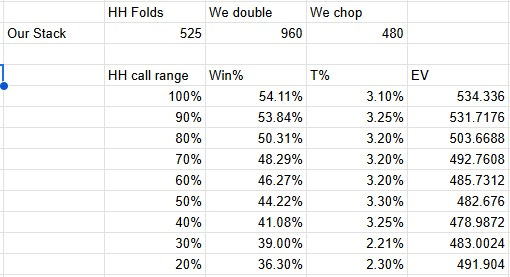
The EV of us folding here is 450k, so vs any calling range shoving is still making more than 1BB, but in tournament poker we frequently give up more than 1bb preflop to avoid getting all-in near the bubble. The irony here is if Hecklen shoved, I’d have comfortably folded, because my instinct is you get to shove all-in wider than calling all-in in almost every tournament spot because you have fold equity, here might be an exception. The FGS of having a slightly larger stack in a bounty is worth a lot and the mincash is relatively small. Maximizing CEV is valuable and if you’re up against a shoving range that might be very weak, calling all-in with a lot of pot equity is more appealing than shoving and frequently getting called with a lot less equity
In chronological order: The Vic, The Hippodrome, Grand Connaught Rooms, The big ball room at the Hilton, Les Ambassadeurs, The Aspers, The Marriott, the small ball room at the Hilton
In chronological order: The Landmark, The Holiday Inn, The Hilton, The Stratford, The Intercontinental, The COMO