

Normally, when there is a big viral poker hand I write about on a weekday POTD blog and break it down like a normal poker hand, but this hand of the week was so odd that I felt that the normal POTD analysis would not be sufficient. I needed to watch the hand several times to figure out exactly what happened. So this blog will be less of a hand history analysis and more of an explainer. What exactly happened? You can watch the video of the HH embedded below or read my transcription below that.

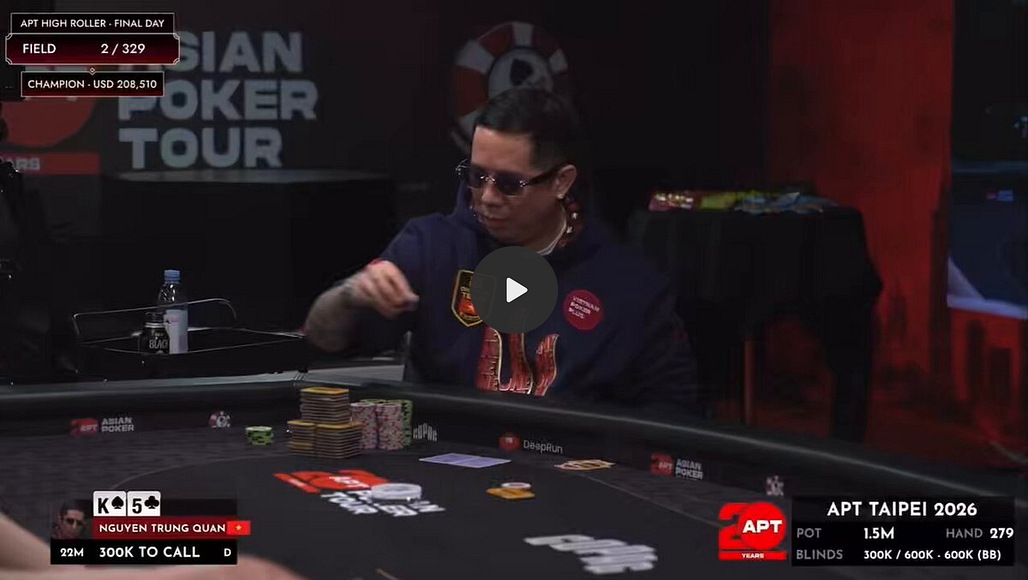
Heads up in the APT Taipei High Roller 1st $208,510, 2nd $128,888
(300k/600k/600k) (SB/BB/BBA)
Nguyen Trung Quan (21M) limps the button, Ritwik Khanna (9.7M) checks.
Flop (1.8M) Q♦️Q♥️6♦️: Ritwik checks, Nguyen bets 600k, Ritwik makes it 1.8M, Nguyen calls.
Turn (5.4M) 6♣️: Ritwik checks, Nguyen bets 1.5M, Ritwik makes it 4M, the dealer announces all-in and throws out an all-in button, Nguyen snap-calls.
The dealer motions for both players to table their hands, neither player does, and the dealer asks Ritwik “you said all-in right?” Ritwik says no, and before he can even say he bet 4M, Nguyen starts animatedly yelling in what I think is Vietnamese, but if I’m wrong please correct me in the comments. I don’t understand much of what Nguyen is saying, but he is very clearly saying “all-in” as in “He said all-in.” Nguyen talks to his rail a little bit, the floor is called over, and while the floor is deliberating, Nguyen starts pumping his fist and celebrating with his rail, takes off his sunglasses and sits there smiling. While Ritwick is sitting down and looks somewhere between uncomfortable and devastated (I recommend you actually watch the video, it will be much more illuminating and entertaining than my description.). Eventually a higher-ranking floor person is called over and it’s ruled that it is a raise to 4M and call. I’ll note this is a case where there was a clear dealer error; it happens, dealing is a hard job, but the floor did make the right ruling. Ideally you’d play in poker tournaments where dealers never make a mistake, but the floor handled this well.
River (13.4M) 3♠️: Ritwick checks, Nguyen shoves for Ritwick’s final 3.9M. Ritwick snap folds K♥️6♥️, Nguyen shows K♠️5♣️.
What Sam Thinks
Let’s get the boring technical details out of the way first. K5o could be a jam preflop and K6s could be a raise-call from Ritwick. However, I’d never raise-call K6s unless it was against an opponent who I am confident would limp-trap 88 sometimes and also limp-jam K2o sometimes. So I like both preflop plays. The flop c-bet seems fine, but it’s easy to overdo it and c-bet too often in a spot like this. Yes, the BB has a weak range preflop, but the button limping range HU isn’t all that strong either.
Since both players can have a lot of 6x, it makes sense you’d raise your strongest 6x hands, and K6 with a backdoor is as strong as you get from the BB, who should have very little A6 after checking preflop. As I joked on Twitter, K5 should fold the flop, but a hand like 87 should not. Having backdoor potential and two overcards to the bottom card is important, as I wrote about yesterday.
The turn is tricky. I can see an argument for Ritwik often betting with range, because he should check-raise the flop with Qx and 6x a lot and thus have a boat a lot. I can also see the argument that Nguyen should often bet-call the flop with a Q or a 6, so he should have a boat a lot and Ritwik should shut down. My instinct is that in general betting any full house here is fine, but K6 seems like one that prefers checking. I’d bet the solver often calls a turn bet with king high, so having a K in our hand is bad. I don’t like Nguyen’s bet. It’s mostly for protection: Ritwik should almost never have ace high or a pocket pair, so king high is either good or is drawing dead. Betting for protection doesn’t make much sense. Similarly, Ritwik should either be facing a full house, pocket pair, or bluff, and raising doesn’t make that much sense from him… that is, unless he thinks Nguyen might be doing something like bet-calling the turn with king high. If so, raising small to squeeze out some value and maybe induce a bluff-shove is the best play.
Which brings us to what actually happened in the hand. Nguyen snap-called. Ritwik called the floor over, which is what you should do in any situation where dealer error makes it unclear what the true action should be. Ritwik saw that if he shoved it would be snap-called. He saw that Nguyen was celebrating with his rail as if he had won the tournament and put him on queens full. With all that commotion going on, he figured there was no way he had the best hand and check-folded the river.
What Ritwik Thinks
Ritwik posted his thoughts on Twitter, but he also DMed me and shared his thoughts.
I have edited them lightly for clarity and formatting, but he wrote that after the check-raise was called.
Now that there’s some confusion in the middle my opponent gets some time to make sense of the situation being very sure that if I had a Q I would not call the floor or stop play and maybe end the tournament right there by acting like the dealer didn’t make any mistake where as I would have still stuck to what my bet size was and not all in cause everything was captured on stream. After figuring I was weak, he started doing theatrics. First by being angry about the situation, why was my all in not counted when the dealer put the all in button and even standing up and celebrating like he has a Q and he won the tournament. After the hand ended he also threw his cards at me indicating that he did what he did to get me to fold better because if he thought I was bluffing he could have easily checked back river with K high and had enough show down.
What I Got Wrong
It turns out K6o jams preflop on the button and K8s can raise-call, but K5o limps and K6s checks. The c-bet is fine, the check-raise is fine, the call of the check-raise is too loose. The turn check is the highest-frequency play, but betting would be fine. Shockingly, king high does bet-call or bet-three-bet shove the turn quite a lot in Nguyen’s shoes. This is also in a world where Ritwik finds a double check-raise with hands like 97o rather often, but it’s still funny to see that, in such a crazy hand, the actual technical poker of this hand outside of calling the flop check-raise with K5 is extremely well played from both.
Final Thoughts
Okay let’s get to the main event here: the river. Of course Ritwick needs to check the river; his turn check-raise was snap called and his opponent was representing a ton of strength. Even if you think it’s a spot where he might bet/snap-call with a hand like 88 or AdKd on the turn, getting those hands to pay off your river jam after he just represented a ton of turn strength will be difficult. This is like checking from the BB to the UTG preflop raiser on AKQ— they might have pocket eights, but you have such a large range disadvantage you need to check. Once Ritwick faces the shove, I am not sure if he should call, but I think he should at least tank. His fold seemed emotional to me; he was flustered by the situation, knew he was beat, and just wanted this whole clusterfuck to end, so he snap-folded.
Ultimately, I think his fold is good. It reminds me a little of this classic hand. In hindsight everyone says it’s so easy and Brett Richey should have folded KK; actually folding KK can be hard to do. Here we have the rare spot where someone is actually bluffing in one of the spots where they “tell you” they have the nuts. It was bound to happen eventually, but it’s very tough to pull the trigger. The only real concern I might have as Ritwick here is that there’s a small chance Nguyen is shoving a chop, but even that seems unlikely given Nguyen’s actions on the turn.
The final question to answer is, was Nguyen angling? If he was angling, was what he did unsportsmanlike? If he was angling, when did he start to angle? Let’s start with the final question. I don’t think the angle started with the snap-call. It is extremely unlikely that Nguyen knew that Ritwick raised to 4 million, but since the dealer erroneously said all-in, he snap-called with the plan of getting Ritwick to fold better for a quarter-pot jam on the river. If he did, he is operating on a higher plane of cognition than me and I have to hand it to him.
I think Nguyen had what I would call a reactive angle, as opposed to a proactive angle. A proactive angle would be something like intentionally putting the wrong number of chips in the pot. I think Nguyen believed Ritwick bluff-raised the turn, and once the commotion started on the turn, Nguyen reacted. He recognized he could represent a lot of strength and pivoted his strategy. Even if you know Ritwick is bluffing, he should have equity vs. K5, and making sure he folds when he improves on the river is worth a lot. I think on a very technical level what Nguyen did is against the rules: He should not be talking to his rail with a live hand at a big FT, and he should not be speaking in a language that is not English or native to Taiwan. However, outside of that I don’t think what he did was unsportsmanlike or an angle. Dealer errors are out of his control, humans will have weird reactions to dealer errors, and whenever there is a dispute about the rules any player’s opponents can get reads on them. Nguyen needs to protect himself for when he actually has a full house. He is not breaking any major rules, and you are allowed to feign strength/weakness and try to trick your opponent in heads-up pots in poker tournaments. I also don’t want to say that $8k and a trophy is “nothing”, but I also think pulling a move like this in a heads up match that doesn’t effect any other players in the tournament after both players have hit a big score is an enviroment where mildly unsportsmanlike should be tolerated, if not accepted.
Ultimately what you had here was a very tricky technical poker hand that was well played, followed by some unusual turn antics, followed by the correct river adjustment from both players. As strange as this hand is, I really feel it was mostly a very well and interestingly played hand that captured how odd a game poker can be. In hindsight, I guess Nguyen should have folded the flop, and I guess Ritwick should have called the river, but I don’t fault either of them for making those plays. What a bizarre hand.
If you’d like to read about the poker world or poker hands, some as bizarre as this one. Please consider becoming a premium, paid, or unpaid subscriber or contact me directly about private coaching.
Additional Sims For Premium Subscribers
Premium Subscribers are given access to a Google Drive folder where they will also be able to download the raw files of sims I used to write my POTDs, sims that are more accurate and appropriate than equivalent sims in the big public libraries. This week I uploaded
A PIO sim using MTT ICM ranges for POTD #276
A PIO sim only giving my opponent once c-bet size for POTD #277
A PIO ICM sim using custom preflop ranges for POTD #278
Additional Analysis for Premium Subscribers
Everyday Premium Subscribers get an extra bit of analysis not included in the main post. Today, I’ll share #onemorething from POTD #277, where I wrote about what I think the ideal river bluff size is for me.
POTD #277 onemorething
When I b10 on the river, I am making king high and pairs between 22-77 indifferent, the same shape holds when I b25, except those hands fold more often. By the time I get to b50 anything worse than top pair is mixing folds. If I bet b75 or b100 some specific top pairs are mixing folds, which I doubt is happening.
So what is the best size to pick? Is B50 getting 9x/8x to fold? I think so, but I am not sure how often. Is it getting KK to fold? Probably not. I think that makes b50 an okay size to pick, especially if it’s vs an opponent who you think will regularly fold 9x or 8x because they are “third pair” or fourth pair”. B75 and B100 both get top pair to fold and I wouldn’t bank on many players making a fold like that to this action. So I definitely prefer b50 to b75 or b100. When it comes to b10 or b25, both block sizes are targeting the same hands, but the key question here is will the larger size actually get him to fold KQ or 54 2.5x as often. I am not sure, I think it’s fair to assume most unknowns are rarely calling the river with any king high combos, but perhaps 10% pot is a little too tantalizing. I’d guess the best size for me to pick exploitatively would be somewhere in between b10 and b25, I think 6k is probably the best size and my quicky and dirty rankings here goes something like.
b10-b25 > b50-b66 > all-in > b66-100
Media
I went long today so, you’ll have to read my thoughts on this season of Top Chef next week.
As always, I can be reached on