

I’ve spent much of this week writing about when to bluff and when not to bluff on the river, and we will continue this theme in the body of today’s post, but I will also write about social bluffing— aka lying. You know when your partner asks “Did you remember to move the clothes from the laundry to the dryer?” and you say “Sure did” while you scramble down to the laundry room? I’ve had many high-level poker conversations with friends, students and rivals, and one term would consistently come up that caused me to bluff: “geometric sizing.” Whenever someone mentioned “sizing geo” or even used the PIO shorthand of “2e” or “3e,” I would “bluff”, by which I mean nod my head as if I knew what they were talking about and make a note to look it up later. I am pretty good at checking my notes, so I would look it up, but then I’d forget what it was the next time the term came up in conversation. My knowing-head-nod game remained strong, but my knowledge of the concept did not.
Maria Konnikova has published a Substack post about how writing (not typing) things down makes it more likely you will remember things, and since I keep forgetting what geometric sizing is, I have figured that I will pick a hand that illustrates the concept and write out a definition, by hand, to help me remember it. When I write POTD #500, ask me what geometric sizing is and I’ll see if I can define it.
So what is geometric sizing, anyways? I will quote an Upswing article that defines the concept.
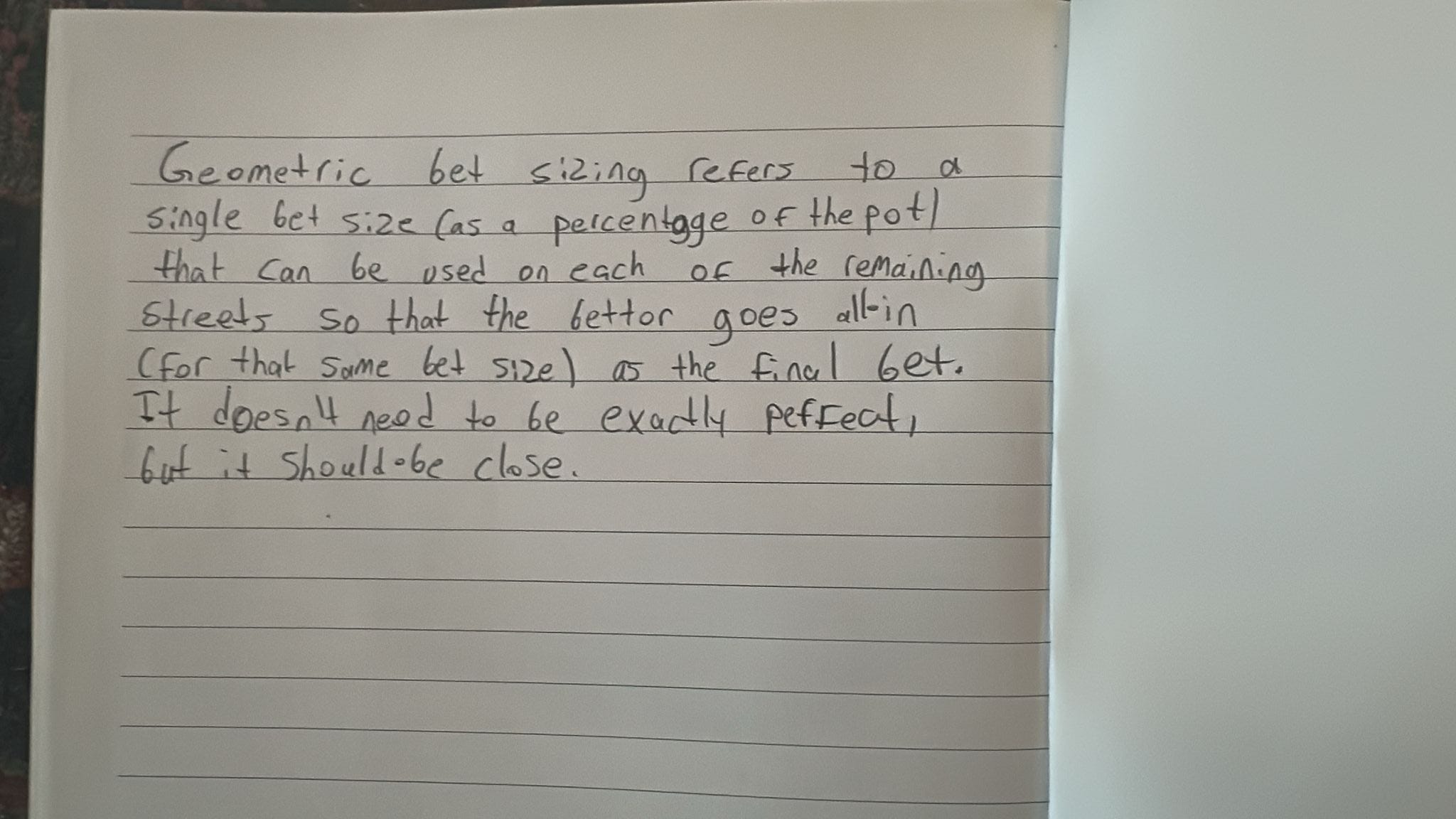
Geometric bet sizing refers to a single bet size (as a percentage of the pot) that can be used on each of the remaining streets so that the bettor goes all-in (for that same bet size) as the final bet. It doesn’t need to be exactly perfect, but it should be close.
And in case you don’t believe that I wrote it down the definition, here is photo evidence. Apologies for my horrible penmanship.
I think most people understand the idea of sizing the turn to set up a river shove even if they’ve never heard the term “geometric bet sizing.” It tends to be used in spots where your most common value bets on one street are also your most common value bets on future streets. AsAd is not a hand you’d want to size geometrically on 7h6h5c, because you are not looking to get stacks in on more than half the deck. AsAd is a hand that you might want to size geometrically on 7s5d2c, where even on a mediocre runout like 5s 6h you still might be comfortable betting full pot on the flop, turn, and river. In today’s hand, I try to go for a geometric bluff vs. Michael Addamo, but I get cold feet on the river. How’d I do? Read on to find out.
Super High Roller Bowl Online #11 25k NLHE
(1k/2k/250) (SB/BB/ANTE) 8 Handed. Registration is open.
It folds to me (130k) in the LJ, I have Q♥️T♣️ and make it 4.4k; it folds to Michael Addamo (covers me) in the BB who calls.
Flop (11.8k) J♥️7♣️3♥️: Addamo checks, I bet 10.5k, Addamo calls.
Turn (32.8k) 2♦️: Addamo checks, I bet 29.5k, Addamo calls.
River (91.8k) 5♣️: Addamo checks, I have 85.6k back and check and lose to Th2h.
What I Was Thinking
I thought QTo was a dicey but acceptable open in the LJ. A jack-high flop with no flushes or straights possible favours the LJ. I was going to play a very high frequency c-bet, but on a board with so many straight draws possible, I figured a big size that makes those hands indifferent made sense as a size for me to pick, and QhTx can profitably barrel a lot of turns. The turn is a total blank, and I thought I would want to check a lot of draws on the turn and stick to bluffing hands like mine. I figured the Qh blocker was useful to block his turn continues and set up some river bluffs, and I could value shove if I rivered top pair. On the river, I felt that I was not supposed to bluff with the Qh because I didn’t want to block hands like Qh7h,AhQh,KhQh,Qh2h and I checked back and lost.
